ENESER 2026 Call for Papers

Artificial Intelligence for Recruitment and Selection: Opportunities, Challenges, and Human Impact

LUMSA University, Rome, Italy July 17-18, 2026

Conference Theme and Scope

Artificial Intelligence (AI) has moved from being a futuristic concept to becoming a pervasive force in contemporary recruitment and selection. Automated screening algorithms, AI-powered chatbots, video-interview analytics, gamified assessments, and generative AI for recruitment marketing are rapidly reshaping the landscape of talent acquisition. Organizations increasingly rely on AI tools to improve efficiency, reduce bias, and enhance candidate experience. Yet, these advances bring with them a complex set of human, motivational, and ethical challenges that the field of selection research must now address. The integration of AI into personnel selection fundamentally changes how candidates and recruiters interact, how decisions are made, and how fairness, transparency, and trust are perceived. While AI promises to make hiring more objective and data-driven, it simultaneously raises questions about algorithmic bias, opacity, and accountability. Moreover, AI alters the very nature of motivation and engagement in both applicants and recruiters: candidates are no longer interacting solely with human assessors but with algorithmic systems that may lack empathy, contextual understanding, and flexibility. 

From a motivational psychology perspective, these changes call for new theoretical and empirical insights. How does interacting with AI influence an applicant’s sense of competence, autonomy, and relatedness? Does the perception of being evaluated by an algorithm affect motivation, impression management, or faking behaviors? Can AI-driven assessments be designed to foster engagement and authenticity rather than anxiety and alienation? Similarly, for recruiters and HR professionals, the increasing reliance on AI might alter their sense of professional identity, autonomy, and responsibility in decision-making. At the organizational level, AI has the potential to transform employer branding and attraction strategies. Generative AI tools are being used to create personalized job advertisements and simulate realistic job previews. Data-driven analytics can help organizations identify and target underrepresented talent pools. However, these same tools may also risk depersonalizing the recruitment process or reinforcing systemic inequalities if not critically monitored and validated. Furthermore, the ethical and societal implications of AI in selection are far-reaching. Scholars and practitioners alike are confronted with questions regarding the ownership of data, the transparency of algorithms, and the potential for discrimination in predictive hiring models. As policymakers move toward regulating AI applications in employment contexts (e.g., the EU AI Act), researchers have an important role in providing evidence-based insights that can guide ethical and effective implementation.

The ENESER 2026 Conference aims to advance our understanding of how AI is transforming recruitment and selection.

 We invite theoretical, empirical, and methodological contributions that examine the human–AI interface through the lenses of motivation, fairness, ethics, and innovation.
Specifically, we encourage submissions that explore—but are not limited to—the following topics:

  1. Applicants’ and recruiters’ motivational and emotional reactions to AI-based recruitment and selection systems.
  2. The effects of algorithmic decision-making on perceived fairness, trust, and organizational attractiveness.
  3. The role of transparency, explainability, and human oversight in shaping positive candidate and recruiter experiences.
  4. Human–AI collaboration in personnel selection: how to integrate automation with human judgment.
  5. Game-based, conversational, and adaptive AI assessments and their implications for engagement, validity, and candidate experience.
  6. Bias mitigation and diversity enhancement through responsible AI design.
  7. Ethical, legal, and cross-cultural perspectives on the use of AI in recruitment and assessment.
  8. The application of motivational theories (e.g., Self-Determination Theory, Expectancy Theory, Goal Setting) to understand behavior in AI-mediated selection contexts.
  9. The impact of AI on recruiters’ professional identity, job satisfaction, and decision accountability.
  10. The use of generative AI in employer branding, candidate communication, and job advertisements.
  11. Methodological innovations for studying AI–human interaction in personnel selection, including experimental designs, simulations, and qualitative approaches.

Ultimately, the conference seeks to stimulate dialogue on how to design AI systems that augment human potential, rather than replace it, and how to ensure that technological progress aligns with psychological well-being, ethical standards, and social inclusion.

Format of the meeting 

Next July, 17-18 we will have two full days of presentations and discussions of approximately 25 papers. This format will allow participants to have ample discussions about their research. There will also be a lot of opportunities for networking and building collaborative project ideas. The event will end at the latest by 6 pm. You will have the opportunity to join a pre-conference dinner on July 16th (more information will follow), we will start the conference with a keynote by Bettina Kubicek from University of Graz, Austria. She will talk about “Aversion or appreciation? Artificial intelligence in personnel selection”.

 Location 

LUMSA University of Rome, ITALY. Piazza delle Vaschette, ROMA, ITALY.

Conference fees (including 2 lunches and coffee breaks during the conference days)

Regular:  € 150 (before April, 30th)      € 250 (after April, 30th)      

 PhD students:  € 100 (before April, 30th)      € 150 (after April, 30th)      

Submission of abstracts 

Participants are invited to submit abstracts (up to 1000 words) by January 26, 2026 to eneser2026@unich.it

 Submissions should be structured as follows: purpose/contribution, design/methodology, results, limitations, implications, and originality/value. In the abstract, the authors should also indicate how their paper fits the scope of the conference. Submitted abstracts will be pre-screened and selected following a blind peer-review procedure. Participants will be notified about the acceptance of their abstract by March 31, 2026.

For further information on LUMSA University, please visit the LUMSA website at https://lumsa.it/en/home

For information on discounted accommodation options for those participating in ENESER 2026, please visit https://lumsa.it/it/convenzioni-commerciali?categorie_convenzione%5B%5D=55

The Scientific Committee

Ioannis Nikolaou
Michela Cortini,
Cristian Balducci,
Ilaria Buonomo,
Teresa Galanti,
Stefania Fantinelli,
Morena Santoriello

ENESER 2026

The 2026 ENESER meeting will be held in Rome, Italy July 17-18, 2026 with the support of LUMSA University.

More information and the call for papers will be circulated among ENESER members in September – October 2025 and will also be published here.

For more information you may contact eneser2026@unich.it

The ENESER 2026 Organizing Committee
Michela Cortini, Cristian Balducci, Paula Benevene, Ilaria Bonomo, Ioannis Nikolaou

ENESER 2020 Call for Papers

Picture 2.png


Picture 1


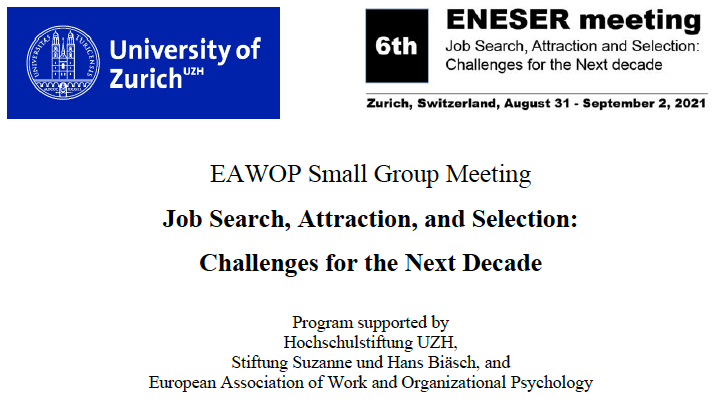
EAWOP Small Group Meeting

Job Search, Attraction, and Selection: Challenges for the Next Decade


June 10-12, 2020

University of Zurich, Switzerland

Organizers: Annika Wilhelmy and Martin Kleinmann


Conference Theme and Scope

The world of work is changing rapidly due to the availability of big data, the development of artificial intelligence, population migration and demographic changes, and yet these changes and their consequences for individuals, organizations, and society are poorly understood. The developments in the world of work also affect how individuals search for jobs, what kind of jobs they feel attracted to, and how they are selected for jobs. Job search, recruitment and selection have been cornerstones of work and organizational psychology for the last 100 years. Vibrant research in these fields has led to countless meta-analyses and literature reviews aiming to drive theoretical developments and best practice approaches to evidence-based management in job search, recruitment, and selection. Despite these efforts, however, it has recently been acknowledged that the fields of job search, recruitment and selection still face just as many (if not more) challenges as one hundred years ago. This is due to various reasons, among which the availability of big data, the development of artificial intelligence, population migration and demographic changes are likely key factors. The aim of the 6th small group meeting (SGM) of the European Network of Selection Researchers (ENESER) is twofold: 1) to advance our empirical and conceptual knowledge of recent developments in recruitment and selection and 2) to bridge scientist-practitioners gaps in new job search, recruitment, and selection practices. Specifically, this SGM aims to explore a number of recent developments in these areas, including:

  1. Research on job search strategies for different groups (e.g. migrants) and their effects in changing work environments.
  2. Research on artificial intelligence and big data in personnel selection and recruitment.
  3. Research on predictors of task, contextual, adaptive, and counterproductive behaviors including boundary conditions of these effects.
  4. Research on applicant reactions, ability to identify criteria, impression management tactics, and applicant faking behavior.
  5. Research on biases in selection and how these biases affect subsequent decision maker behavior and selection outcomes.
  6. Research on applicant expectations and perceptions of traditional versus technology-based assessment, recruitment, and selection procedures.
  7. Research on interviewers’ perception on the role of technology in job search, recruitment, and selection.
  8. Research on applicant job search behaviors, attraction to organizations, job choice, and intentions to accept job offers.
  9. Research on applicant withdrawal behaviors at various stages of the recruitment and selection process.
  10. Research on ethnic, gender, and age differences in assessment of task, contextual, and counterproductive behaviors and their effects on recruitment and selection outcomes.

Format of the meeting

The meeting will start on June 10, 2020 with a reception in the late afternoon. On June 11 and 12, we will have two full days of presentations and discussions of approximately 25 papers. This format will allow participants to have ample discussions about their research. There will also be a lot of opportunities for networking and building collaborative project ideas. The event will end at the latest by 6pm on June 12. Additionally, after the official end of the meeting, a public viewing event for the opening match of the European Football Championship can be attended on a voluntary basis.

Location

The conference will be held in Zurich, Switzerland. Zurich has a unique position in Switzerland. It is the country’s largest city and home to an internationally reputed financial center as well as the focus of an economic region which acts as the motor of Switzerland. The wide variety of cultural activities and educational institutions define Zurich’s character as a diverse, open city with a passion for life. It is famous for its lakeside location and green, densely wooded chain of hills which run through the city from north to south with views to the Alps. The high standards of living, working, and accommodation are regularly confirmed in surveys of the local residents, and Zurich consistently finds itself at the top of international rankings of cities in terms of quality of life. By the way, Zurich is also the home of the FIFA World football museum. The Small Group Meeting will take place at the University of Zurich. Its central location is ideal for different accommodation, dining and entertainment options.

Conference fees

The conference fee is 120 CHF and 60 CHF for PhD students (please provide a copy of your student ID), which includes lunches, coffee/tea, a conference dinner, and drinks at the welcome reception. Travel and accommodation costs have to be covered by participants.

Submission of abstracts

Participants are invited to submit paper abstracts (up to 1000 words excluding references; max. two additional pages of tables and figures) by January 15, 2020 to Annika Wilhelmy (a.wilhelmy@psychologie.uzh.ch). Submissions should be structured as follows: purpose/contribution, design/methodology, results, limitations, implications, and originality/value. In the abstract, the authors should also indicate how their paper fits the scope of the SGM. Submitted abstracts will be pre-screened and selected following a blind peer-review procedure. Participants will be notified about the acceptance of their paper by March 15, 2020. Upon the abstract acceptance, all participants should pay the participation fee by March 30, 2020. 

Dissemination activities

The SGM plans to yield a product available free of charge to the EAWOP members. Therefore, the organizers plan to submit a position paper for publication in EJWOP. In addition, there may be a special issue, for example in the International Journal of Selection and Assessment, which will be further discussed at the ENESER meeting.

University of Bradford, Faculty position

Faculty of Mgmt, Law and Social Sciences

School of Management

Salary:  per annum
Various dependent on grade
Post Type:  Full Time
Closing Date:  Friday 12 April 2019
Reference:  HR0074595

For over fifty years, the University of Bradford has been international leader in business research and management education. The School of Management is pioneer in developing new programmes and courses that reflect and anticipate the needs of employers and of society as a whole. The School of Management is part of an elite group of business schools worldwide possessing triple-crown accreditation from AACSB, AMBA and EQUIS.

The People, Organizations and Entrepreneurship (PO&E) Research Centre is an intellectually stimulating, creative and research-driven Centre that combines expertise in the areas of Human Resources Management, Organization Behaviour, Innovation, Creativity and Entrepreneurship. In line with our growth strategy, we seek to appoint Lecturers and Senior Lecturers in the general fields of Human Resource Management / Organizational Behaviour (HRM-OB) to contribute to existing and new programmes as well as advance understanding in key areas of research. Appointments will be made in all areas but could include international HRM, leadership, entrepreneurship, organizational psychology, and well-being at work, among others, preferably with knowledge of relevant research methods.

We are looking for enthusiastic and highly motivated individuals who can make a significant contribution to the implementation of our research, teaching and learning strategy. The PO&E Centre has an international reputation in its key areas of research; members have published in 4-star ‘Journal of Distinction’ and 4-star journals, and have active research funding from the ESRC, British Academy, Leverhulme Trust, and NASA. Teaching duties will include contributing effectively to the undergraduate and postgraduate programmes in Management and in Human Resources Management which are accredited by the Chartered Institute of Professional Development (CIPD). You will also be expected to contribute to the Research degrees and be willing to develop and deliver digital-distance learning content on our FT ranked MBA programme.

Applicants must possess a Doctorate in a relevant field and for the HRM vacancies be CIPD and/or BPS (British Psychological Society) Occupational members, or at least have the qualifications to become members. They should also possess, along with significant teaching experience, an active research profile with a demonstrable research record with publications in 3 and/or 4* ABS-listed journals, preferably with a record of winning-in grant funds, collaborations with industrial partners, and professional service.Senior Lecturers will be expected to provide programme leadership and contribute to the design of innovative programmes within the School and Faculty and create knowledge through fundamental and applied research.

Informal enquiries should be directed to Prof. Neil Anderson, the Head of the People, Organizations and Entrepreneurship Research Centre (n.anderson@bradford.ac.uk).

To view full vacancy details and to apply please click on the links below:

Senior Lecturer in HRM (grade 9 /10 £42,036 – £58,089) – http://jobs.bradford.ac.uk/POEVAC1

Senior Lecture/ Lecturer in Ethics and Corporate Social Responsibility  (grade 9 /10 £42,036 – £58,089) – http://jobs.bradford.ac.uk/POEVAC2

Lecturer in People, Organisation and Entrepreneurship (grade 8 /9 £35,211 – £48,677) – http://jobs.bradford.ac.uk/POEVAC3

Lecturer in Entrepreneurship – (grade 8 /9 £35,211 – £48,677) – http://jobs.bradford.ac.uk/POEVAC4

Email details to a friend
Further details:

Call for Papers EJWOP Special Issue

Screenshot 2018-10-05 at 22.52.23

Recent Developments in Recruitment and Selection: European Perspectives and Advances

Recruitment and selection has been one of the cornerstones of work and organizational psychology for the last 100 years (Nikolaou & Oostrom, 2015; Ployhart, Schmitt, & Tippins, 2017). The vibrant research in this field has led to different meta-analyses and literature review papers aiming to drive both, theoretical developments and best practice approach to evidence-based management in recruitment and selection. Despite these efforts, however, the field of recruitment and selection still faces a number of challenges, which have become ever more complex and difficult to address (Ployhart et al., 2017; Ryan & Ployhart, 2014). For instance, an increasingly more volatile and uncertain organizational environments and changing labour regulations have significantly shaped selection and recruitment practices. The field has also moved on from predicting job performance to addressing more pertinent issues of the modern workplaces, such as exploring the role of technology and internet in recruitment and selection, studying new selection methods and approaches and focusing on predicting other than routine task-related behaviours (Bledow & Frese, 2009; Nikolaou & Oostrom, 2015; Potocnik & Anderson, 2012; Potocnik, Anderson, & Latorre, 2015).

This special issue aims to explore a number of such recent developments in the recruitment, selection, and assessment research and the submissions to this special issue could cover, but are not restricted to the following topics:

1. Research on applicant perspective, including applicant reactions, impression management tactics, ability to identify criteria, and applicant faking behavior;
2. Research on biases in selection and how these biases affect subsequent interviewer behavior and interview outcomes;
3. Research on traditional versus technology based assessment, recruitment and selection procedures;
4. Research on job search behaviors, attraction to organizations, job choice, intentions to accept job offers;
5. Research on interviewer and recruiter’s discriminatory behaviors and techniques to reduce adverse impact;
6. Research on ethnic / gender / age differences in assessment of task, contextual and counterproductive behaviors and their effects on recruitment and selection outcomes;
7. Research on new recruitment and selection methods and new constructs;
8. Research on cross-cultural issues in recruitment and selection;
9. Research on how selection and recruitment procedures affect internal organizational processes, including employee attitudes and behavior.

Submission Instructions

We invite original empirical and literature review papers that represent novel and significant efforts to address recent developments in recruitment and selection. Empirical papers that rely exclusively on self-reported cross-sectional data will be desk rejected. Furthermore, manuscripts using only student samples need to have clear implications for practice. Review papers have to be based on a systematic literature review and/or meta-analytic methods.

Manuscripts should be submitted by June 1st, 2019. We aim to complete the first round of reviewing by September 1, 2019. The projected date of publication of the special issue is the first half of 2021.

Papers should be submitted through the journal’s online submissions website via https://mc.manuscriptcentral.com/pewo, identifying the paper as a submission for this Special Issue.

Further information on EJWOP manuscript requirements is available on the journal’s website.
For further information, or to discuss article ideas, please feel free to contact any of the Guest Editors: Kristina Potocnik (Kristina.Potocnik@ed.ac.uk); Neil Anderson (N.Anderson@bradford.ac.uk); Marise Born (m.ph.born@essb.eur.nl); Martin Kleinmann (m.kleinmann@psychologie.uzh.ch); and Ioannis Nikolaou (inikol@aueb.gr).

Editorial information